
Beyond the Splash: Finding the Best Water Bowl for Messy Cat Drinkers in 2026

What if the standing water in your cat’s bowl is actually encouraging the very splashes you spend your mornings mopping up? Most owners of messy drinkers assume that damp hardwood and a constant splash zone are just inevitable parts of living with a pet. It's a daily frustration that disrupts the flow of a modern home and risks long-term water damage to your floors.
Finding the best water bowl for messy cat drinkers requires a shift in perspective. You shouldn't have to settle for stagnant water or the constant maintenance of biofilm buildup to keep your pet healthy. We'll show you why traditional open bowls fail and how a sophisticated hydration solution can maintain a clean, minimalist aesthetic while protecting your environment.
This guide explores the logic of controlled water exposure and how it prevents the mess before it starts. You'll discover how to provide cleaner, filtered water for your cat through systems that manage flow, such as Torus Pet, ensuring their wellbeing without compromising your home's design. It is time to move beyond the splash and embrace a more intelligent approach to feline hydration.
Key Takeaways
- Understand the biological drivers behind splashing, including how cats use their paws to gauge water depth and surface visibility.
- Learn why traditional open bowls often lead to floor damage and how their design contributes to rapid biofilm buildup.
- Identify the essential features of the best water bowl for messy cat drinkers, prioritizing controlled water exposure over simple bowl weight.
- Discover how a sophisticated hydration solution maintains a clean, modern aesthetic while protecting your home from water damage.
- Explore the benefits of gravity-powered systems that offer quiet, non-electric operation for a more peaceful and efficient household.
Table of Contents
Why Traditional Cat Bowls Fail Messy Drinkers
Most pet owners assume a bowl is just a bowl. They follow the standard industry advice to buy something "shallow and wide" to prevent whisker fatigue. While this sounds logical, it often ignores the reality of feline behavior. If you're searching for the best water bowl for messy cat drinkers, you've likely realized that a simple open pool of water is often an invitation for chaos rather than a source of hydration.
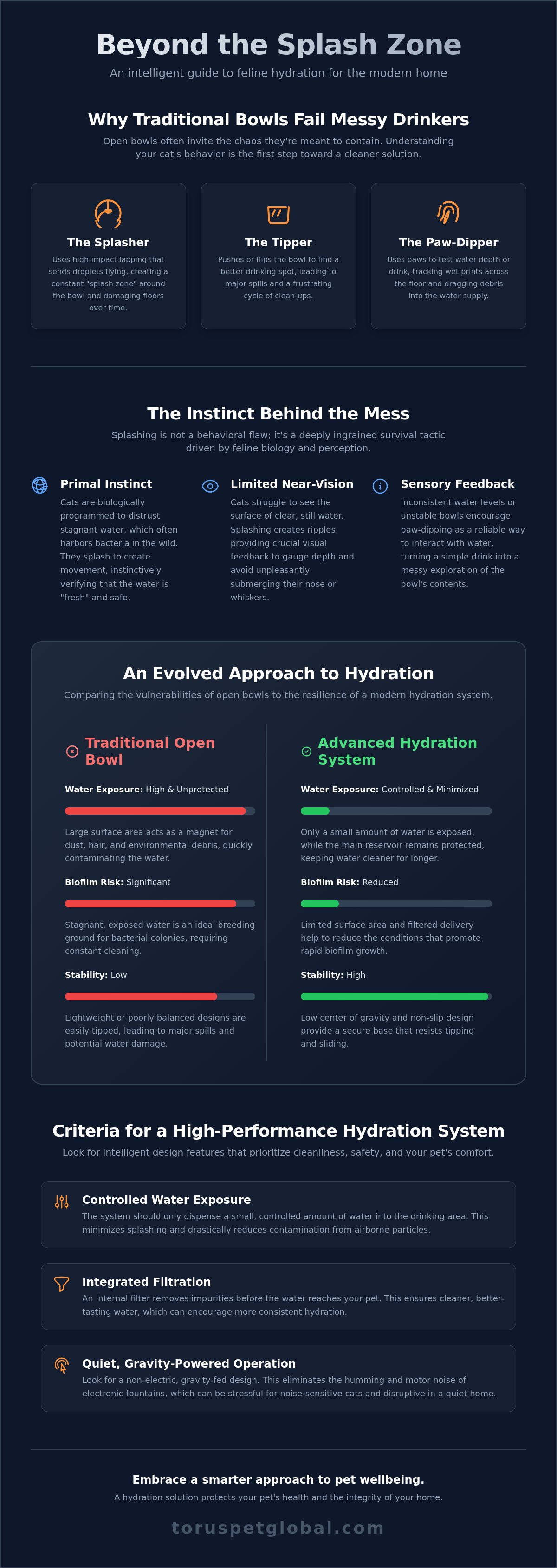
The "Messy Drinker" isn't a single type of cat. We generally see three distinct profiles in modern homes. The Splasher uses high-impact lapping that sends droplets flying. The Tipper prefers to move the bowl to find a "perfect" spot, often resulting in a flooded floor. Finally, the Paw-Dipper uses their paws to test depth or pull water toward them, dragging debris into the bowl in the process.
Traditional vessels fail these cats because they are passive objects. They provide zero resistance to tipping and no containment for splashes. A true hydration solution, by contrast, manages how water is delivered and stored. It moves away from the idea of a static reservoir and toward a system that actively protects the water and your home environment.
The Whisker Fatigue Paradox
Whisker fatigue is a real sensory overload issue. When a cat's sensitive whiskers touch the sides of a deep, narrow bowl, it causes significant stress. The common fix is to provide a wide, flat dish. This solved the fatigue but created the "splash zone" that plagues many hardwood floors.
High-impact lapping is a core part of how cats drink, and a shallow dish offers no protection against the resulting spray. You don't have to choose between your cat's comfort and a dry floor. The middle ground involves ergonomic access that controls the amount of water exposed at any given time, providing comfort without the mess. The Torus Mini is specifically designed to reduce splashing for cats, allow the cat to see fresh water flowing in to the drinking well, and with a wide profile to accomodate whiskers.
The Problem with High Surface Area
Large, open pools of water are magnets for environmental contaminants. Every hour that water sits exposed, it collects dust, dander, and loose hair. This isn't just an aesthetic issue; it impacts the quality of the hydration your cat receives. High surface area also accelerates evaporation and creates a breeding ground for bacteria.
Biofilm is a bacterial colony that thrives in stagnant, exposed water. Systems that control water exposure, like Torus, represent a shift in thoughtful pet care. By limiting the surface area and keeping the main reservoir protected, you ensure the water remains cleaner for longer. It is a more intelligent way to handle feline hydration in a design-conscious home.
The Mechanics of Feline Hydration: Why Your Cat Splashes
Splashing isn't a behavioral flaw. It's a survival tactic. Cats are biologically programmed to distrust stagnant water. In nature, still water often harbors bacteria, while moving water is generally safer. This instinct remains strong in indoor cats, leading them to "test" the water in their bowl by splashing or pawing at the surface to ensure it's fresh and safe to consume.
The importance of hydration for cats cannot be overstated, yet their own biology makes drinking from a standard bowl difficult. Because cats have limited near-vision, they struggle to see the surface of clear, still water. They splash to create ripples, which provide the visual feedback they need to gauge depth before they commit to drinking. Without these ripples, they risk dipping their nose or whiskers too deep, which is an unpleasant experience for any feline.
In modern homes, this behavior is often amplified by environmental boredom. If a cat finds that hitting the water creates an interesting visual or auditory response, they'll repeat the action. Traditional bowls often trigger the "tipping" instinct because they're unstable. When a cat feels a bowl shift under their weight or paw, it can turn a simple drink into a game of physics that ends with a flooded kitchen floor. All Torus water bowls have special rubber feet that prevent sliding as well as dragging but the cat.
Paw-Dipping and Sensory Feedback
Cats often resort to drinking from their paws when they feel uncertain about the water source. This behavior usually stems from inconsistent water levels or a lack of visual cues. While it might look like play, it's actually a calculated attempt to avoid submerging their nose or whiskers. The resulting mess of wet paw prints and splashed water is a direct result of a vessel that doesn't provide reliable sensory feedback.
Understanding the mechanics of how water is delivered helps in selecting a system that aligns with these biological needs. Controlled-level dispensers eliminate the need for depth-testing ripples by keeping the water height constant and predictable.
The Tipping Point: Physics of the Mess
Instability is the primary reason for a flooded floor. Lightweight plastic bowls are easily nudged or flipped by an active cat. Even heavy ceramic options often have a high center of gravity, making them vulnerable to "tipping" behavior. When a cat feels the bowl move, it often triggers a predatory response, leading to more aggressive tipping.
A truly effective best water bowl for messy cat drinkers utilizes a low-profile, high-mass design that resists movement regardless of the cat's enthusiasm. By lowering the center of gravity and increasing the footprint of the hydration system as found with Torus water bowls, you remove the physical opportunity for the cat to flip their water supply. This provides peace of mind for the owner and a more reliable resource for the cat.
Evaluating Solutions: Heavy Ceramic vs. Splash-Proof Systems
Many owners believe that weight is the ultimate defense against a messy drinker. They invest in heavy ceramic crocks, assuming that if the cat can't move the vessel, the floor will stay dry. This logic fails to account for the energy of the splash itself. While weight prevents tipping, it does nothing to contain the high-velocity droplets created by an enthusiastic lapper. Finding the best water bowl for messy cat drinkers requires looking past mass and toward design that manages water movement.
Material choice is equally critical for long-term health and home maintenance. Stainless steel is often praised for being non-porous, yet it's loud and can develop a metallic taste that discourages drinking. Ceramic is aesthetically pleasing but can harbor bacteria in microscopic cracks or chips. Advanced, food-grade polymers offer a sophisticated alternative, combining the durability of steel with the quiet, clean profile required for a modern living space.
The shift toward "Smart Hydration" represents the next evolution of pet care. It moves away from passive containers and toward active systems that protect the water from the environment. These solutions are designed for owners who value both the wellbeing of their cat and the integrity of their home's interior design.
The Maintenance Trap of Electronic Fountains
Electronic fountains are often marketed as the pinnacle of feline care. However, they introduce a significant maintenance burden that many owners find exhausting. Slimy pumps, narrow tubes, and hidden chambers are notorious for harboring biofilm. These systems require frequent teardowns and specialized brushes to maintain even a basic level of hygiene.
Non-electric, gravity-fed systems provide the same fresh water benefits without the mechanical complexity. They eliminate the noise of a motor and the risk of bacterial growth in inaccessible components. For a quiet, minimalist home, a system that delivers water without a power cord offers a much cleaner aesthetic and significantly easier upkeep.
Material Science and Antimicrobial Properties
The surfaces that touch your cat's face directly impact their dermatological health. Porous materials are a primary trigger for feline chin acne because they trap oils and bacteria against the skin. By utilizing non-porous, antimicrobial materials, you help reduce exposure to these common irritants. It's a simple change that supports long-term health.
Understanding feline hydration needs involves recognizing that water quality is just as vital as quantity. Modern hydration solutions focus on reducing contamination risk through material science. For a deeper dive into these mechanics, explore The Science of Feline Hydration to see how design impacts water purity and delivery.
Strategic Hydration: Criteria for the Modern Pet Home
A sophisticated home requires solutions that work silently in the background. When you prioritize design, every element of your environment matters, including how your cat accesses water. The best water bowl for messy cat drinkers isn't just a container; it's a piece of functional technology that respects your space. Strategic hydration such as that provided by Torus water bowls, means moving away from the "open pool" model and toward a system that integrates seamlessly with a minimalist lifestyle.
Controlled Water Exposure Explained
Controlled water exposure is the primary differentiator between a basic vessel and a professional hydration system. Traditional bowls present a large, static pool that invites paw-dipping and high-impact lapping. By contrast, on-demand delivery ensures that only a small amount of water is accessible at any time. This drastically reduces the physical opportunity for a cat to create a splash zone on your tile or hardwood floors.
Keeping the bulk of the water supply in a protected, internal reservoir is a hallmark of intelligent design as seen with Torus Pet. It prevents the rapid development of biofilm and shields the water from airborne particles like dust or dander. This setup ensures that every sip is as fresh as the first, regardless of how long it's been since the last refill. It is a more logical way to manage resources in a busy household.
Filtration and Long-Term Wellbeing
Filtration is a vital pillar of long-term feline health. Cats have a highly developed sense of smell, and the scent of chlorine or stale water can easily discourage them from drinking enough. Activated carbon filters work to remove these odors, making the water more palatable and encouraging healthy hydration habits without the need for constant human intervention.
Advanced filtration is designed to help reduce exposure to common tap water impurities and organic compounds that affect taste. When water is clean and smells neutral, cats are more likely to drink without the need for "testing" the surface with their paws. This creates a positive cycle of health and cleanliness that protects both your pet and your home's aesthetic.
The refill dynamic also changes with a larger internal reservoir. Busy owners don't need to monitor water levels multiple times a day, as a high-capacity system manages delivery automatically. Whether you are moving the station for a dinner party or traveling for the weekend, your hydration system should be as mobile as you are. A truly professional solution maintains its integrity across different environments, ensuring your cat's routine remains undisturbed.
Discover how sophisticated hydration technology can protect your home and enhance your cat's wellbeing.
Implementing a High-Performance Hydration System
Transitioning to a professional hydration system is a proactive step for both your pet’s wellbeing and your home's longevity. Many owners assume that high-performance solutions require complex electronics or noisy motors. In reality, the best water bowl for messy cat drinkers utilizes physics-based delivery to manage flow without disrupting the quiet of a modern home.
A sophisticated system like Torus moves away from the open-dish model that encourages splashing. By integrating a hydration routine into your weekly schedule, you replace the daily chore of mopping with a streamlined maintenance process. It is about working with your pet's natural instincts rather than fighting against them.
Design Logic: From Passive Vessels to Active Systems
Structural stability is essential for protecting expensive flooring from the cumulative effects of moisture. A high-performance Pet Hydration Solution utilizes a low-profile, non-tipping geometry to ensure the unit remains stationary even when approached by high-energy cats. This design eliminates the risk of a flooded kitchen floor caused by a tipped or nudged bowl.
Systems that control water exposure, such as Torus Pet, deliver water on demand from a protected internal reservoir. This design keeps the main supply cool and clean without the need for external power cords or mechanical pumps. It is a self-contained solution that maintains water purity while fitting seamlessly into a minimalist aesthetic.
Maintaining Your Hydration Solution
Longevity and performance depend on consistent, simple care. Cleaning a high-performance dispenser doesn't require specialized tools; a quick rinse and the use of a dedicated cleaning kit will keep surfaces free from mineral buildup. This ensures the internal valves and delivery systems function reliably for years, respecting both your time and your home's cleanliness.
Regular filter replacement remains the most important step for maintaining water quality. Activated carbon filters should be changed based on usage to ensure the water remains palatable and free from tap water odors. For specific maintenance insights, you can explore the mechanics of these systems to see how they are designed for long-term reliability and effortless upkeep.
Elevating the Standard of Feline Hydration
Managing a messy drinker is less about correcting feline behavior and more about selecting the right infrastructure for your home. When you move away from high-surface-area dishes and embrace controlled hydration, you eliminate the sensory triggers that lead to splashing. The best water bowl for messy cat drinkers is ultimately one that respects the biological needs of the animal while maintaining the aesthetic standards of a modern living space.
A sophisticated hydration system provides peace of mind through antimicrobial protection and a stable, non-tipping geometry. By choosing a solution that delivers water on demand, you protect your home’s environment from moisture damage and simplify your daily maintenance routine. This approach ensures that your cat has access to cleaner, filtered water without the noise or complexity of electronic fountains.
The final takeaway for the thoughtful pet owner is that hydration should be treated as a sophisticated element of modern care. It involves how water is stored, filtered, and delivered to ensure long-term wellbeing. To see how these principles are applied in a high-performance design, you can explore advanced hydration systems tailored for contemporary homes. True pet care is found in the intersection of health, design, and effortless functionality.
Frequently Asked Questions
Why does my cat splash water out of the bowl with their paws?
Cats splash primarily to create visual ripples that help them gauge the water’s depth. Because felines have limited near-vision, still water is often invisible to them. Splashing provides the sensory feedback they need to avoid submerging their nose. It is also a biological drive to verify that the water source is fresh and moving rather than stagnant.
Can a heavy ceramic bowl stop my cat from tipping it over?
A heavy ceramic bowl provides mass that prevents tipping, but it doesn't address the underlying cause of messy drinking. While the bowl may stay in place, the large open surface area still invites splashing and paw-dipping. A more effective approach involves using a system with a low center of gravity and controlled water exposure to minimize the opportunity for mess.
Are electronic water fountains better for messy drinkers?
Electronic fountains can encourage hydration, but they often introduce maintenance challenges for messy drinkers. The motors and pumps are difficult to clean and can harbor biofilm in hidden chambers. Non-electric, gravity-fed systems provide the benefit of fresh water without the complexity of power cords or the risk of bacterial growth in inaccessible mechanical parts.
What is whisker fatigue and does it cause messy drinking?
Whisker fatigue is a sensory overload caused by whiskers touching the sides of a narrow bowl. This stress often leads cats to paw water out of the dish to drink from the floor. The best water bowl for messy cat drinkers solves this by providing a wide, ergonomic drinking area that controls water levels to prevent both fatigue and splashing.
How often should I clean my cat’s water dispenser to avoid biofilm?
You should clean your hydration system at least once a week to ensure optimal hygiene. Biofilm is a bacterial colony that develops quickly in stagnant, exposed water. Regular maintenance with a dedicated cleaning kit, combined with monthly filter replacements, helps reduce exposure to contaminants and keeps the water tasting fresh for your cat.
Is filtered water better for cats who are picky or messy drinkers?
Filtered water is essential for picky drinkers because it removes chlorine and organic odors that cats find off-putting. When water smells neutral, cats are less likely to "test" it with their paws, which reduces splashing. Providing cleaner water through activated carbon filtration encourages better hydration habits and helps maintain a more hygienic environment in your home.
How do I stop my cat from "playing" in their water bowl?
Stopping water play requires removing the visual and tactile rewards that splashing provides. By switching to a system that limits the amount of exposed water, you make the bowl less interesting as a toy. On-demand delivery systems ensure that water is for hydration only, effectively discouraging the "dip and lick" method that leads to wet floors.
Are there non-electric water dispensers that are spill-proof?
Sophisticated non-electric dispensers, like the Torus hydration solution, are often the best water bowl for messy cat drinkers seeking a silent, stable option. These systems use internal reservoirs and gravity to deliver water without electronics. Their low-profile geometry and high mass when filled make them nearly impossible to tip, even for the most active and determined cats.