
Choosing a Non-Tipping Water Bowl for Puppies: A Guide to Stable Hydration

What if the constant puddle on your kitchen floor isn't a behavior problem, but a design flaw? Many owners assume that a playful puppy simply needs more discipline. In reality, the traditional bowl is often an invitation to chaos. Finding a high-quality non-tipping water bowl for puppies is about more than just adding weight. It's about shifting the center of gravity and rethinking how water is delivered.
We understand the frustration of seeing expensive hardwood or tile damaged by standing water. You want a home that feels like a sanctuary, not a splash zone. It's exhausting to constantly refill a bowl that has been treated like a toy. This guide will show you how to transition from messy spills to a well designed and modern hydration system like Torus that keeps your puppy's water clean and your environment dry.
We'll explore the mechanics of stability and the benefits of advanced pet hydration solutions, such as those designed by Torus, which prioritize controlled water exposure over open, vulnerable reservoirs. You'll discover how a smart approach to design can eliminate the mess while ensuring your puppy remains healthy and hydrated.
Key Takeaways
- Understand why traditional bowls invite spills and how a puppy's natural curiosity turns a high center of gravity into a household mess.
- Learn the mechanics of choosing a non-tipping water bowl for puppies that utilizes intelligent geometry and a broad base to resist lateral force.
- Discover how systems that control water exposure help reduce exposure to dust and debris compared to stagnant, open-air bowls.
- Evaluate hydration solutions by their capacity to support a growing puppy while maintaining a clean, modern home aesthetic.
- Shift your perspective from basic water bowls to sophisticated hydration systems that prioritize long-term health and minimal maintenance.
Table of Contents
The Puppy Hydration Challenge: Why Traditional Bowls Fail
Weight is the most common solution proposed for messy puppies, but it is also the most incomplete. While a heavy ceramic dish might resist a nudge, it does nothing to address the behavioral mechanics of a young dog. Finding a reliable non-tipping water bowl for puppies requires looking beyond mass. Puppies don't just see water as a resource; they see it as a sensory playground. Traditional bowls fail because they ignore this fundamental curiosity and lack the stability required for an active home.
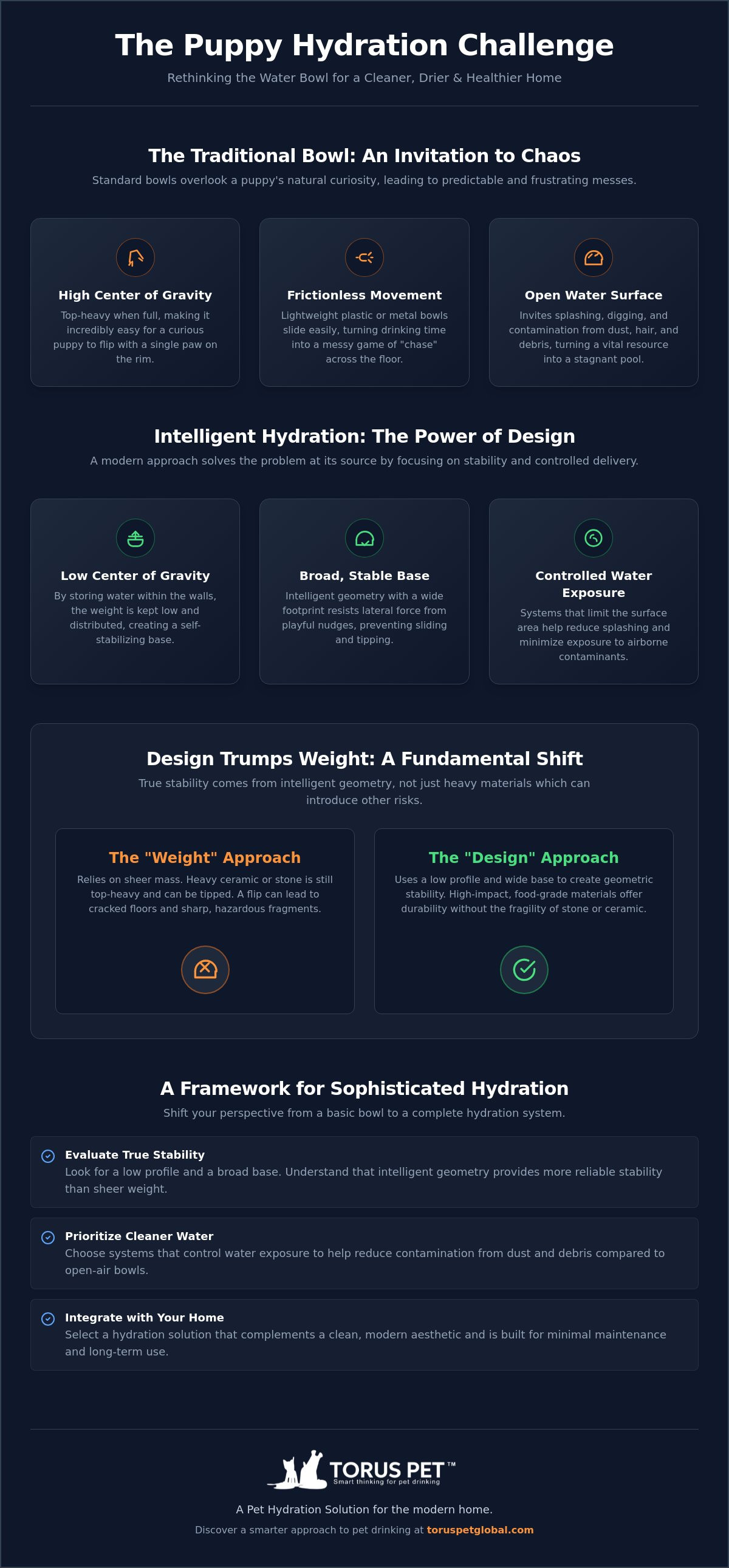
Standard bowl designs suffer from several critical flaws that invite chaos into a modern living space:
-
High Center of Gravity: A bowl filled with water is top-heavy. This makes it easy to flip when a puppy places a paw on the rim.
-
Frictionless Movement: Lightweight materials allow the bowl to slide. This turns hydration into a game of "chase" across your kitchen floor.
-
Open Exposure: Unprotected water surfaces invite digging and splashing behaviors that lead to saturated surroundings.
Transitioning to a sophisticated hydration mindset means moving away from simple containers. We must stop viewing the bowl as a "dumb" object and start seeing it as a managed system. This involves controlling how water is stored and delivered, rather than leaving a vulnerable pool of liquid exposed to the environment. When you prioritize design over weight, you solve the problem at its source.
The Instinctual Urge to Splash
Many puppies exhibit a "digging" behavior in their water. This isn't just play; it's an instinctual response to the reflection and movement of the water's surface. The shimmering light attracts their attention, prompting them to "catch" the movement. This interaction almost always results in a tipped bowl or a saturated environment. Open water also catches dust and hair. It turns a vital resource into a stagnant pool that requires constant maintenance and cleaning.
Reframing the Mess as a Health Concern
Spilled water is more than a nuisance for your hardwood floors. Standing water in a home environment creates a breeding ground for bacteria. When a puppy tips their bowl, they lose access to consistent hydration until you notice the mess. This inconsistency can disrupt the delicate balance of puppy nutrition and overall wellness. Growing dogs require steady access to clean water to support their development.
Relying on reactive cleaning isn't a sustainable strategy for the modern pet owner. A proactive approach involves using systems like Torus that control water exposure, like Torus, to ensure water remains clean and contained. By understanding how it works, you can move away from the frustration of soggy floors and toward a sophisticated, stable hydration routine that respects your home and your puppy's health.
Mechanics of Stability: Why Design Beats Weight
A common mistake in pet care is equating weight with stability. While a heavy stone dish feels sturdy, it often hides a high center of gravity that a determined puppy can easily exploit. A true non-tipping water bowl for puppies relies on intelligent geometry rather than just mass. It uses a broad base and a low profile to resist lateral force, ensuring the bowl stays upright even during energetic play. By distributing weight across a larger surface area, the design makes it physically difficult for a puppy to find the leverage needed for a flip.
The physics of the Torus shape offers a unique solution to this problem. By storing the main water supply within a hollow, outer wall, the system creates a self-weighting effect. The Torus' rubber feet mean no more sliding across the tiles. No more sudden flips. Just a stable, reliable source of hydration. As the puppy drinks, the weight remains distributed at the perimeter, where it is most effective at preventing a tip. This design eliminates the need for clumsy mechanical attachments like suction cups or stickers, which often fail on textured hardwood or stone floors. Geometric stability is permanent; mechanical solutions are temporary.
Reliance on heavy ceramic alternatives can introduce unnecessary risks into the home. If a puppy manages to flip a heavy dish, it can crack or chip, creating sharp edges and potential hazards for both the pet and the owner. Modern, design-conscious owners prefer high-impact, food-grade materials that offer durability without the fragility of stone or porcelain. Design-led stability provides peace of mind that weight alone cannot match.
Center of Gravity and Geometric Balance
A narrow-base bowl is inherently unstable. When a puppy nudges the rim, the force acts as a lever, easily toppling the contents. Storing water in the perimeter lowers the tipping point and creates a grounded feel. This wide-profile reservoir resists the lateral pressure of a puppy's paw better than any weighted center dish. Puppies quickly lose interest in tipping bowls that don't wobble or slide, as the lack of feedback ends the "game" of movement. You can explore the science behind this low-profile stability to see how it transforms daily maintenance.
Material Integrity in Modern Pet Care
Sophisticated pet care involves more than just stability. It requires materials that support long-term wellness. High-impact, antimicrobial surfaces help reduce exposure to bacteria and maintain a cleaner hydration environment. This aligns with broader health standards, such as those found in veterinary guides on 10 ways to care for your puppy. Choosing materials that complement a clean home aesthetic ensures that your puppy's hydration station feels like an integrated part of your living space rather than a cluttered afterthought.
Evaluating Non-Tipping Solutions: A Framework for Owners
Selecting a non-tipping water bowl like Torus for puppies shouldn't be a matter of trial and error. Many owners resort to heavy kitchenware or DIY hacks; however, these rarely address the specific needs of a developing dog. A truly effective solution must be evaluated through a framework of stability, capacity, and long-term maintenance. It's about finding a system that simplifies your routine while protecting your home environment.
Stability is the baseline. While we have explored the physics of geometry, you must also consider your specific flooring. Suction-based bowls often fail on the very surfaces they are meant to protect, such as textured tiles or expensive hardwood. A better approach is a self-weighted design that remains grounded through its own water-filled reservoir. This ensures the bowl stays upright without damaging your home's aesthetic.
Capacity and maintenance are equally vital. A growing puppy's hydration needs change quickly. A small bowl leads to frequent refills and the risk of dehydration if you're away for a few hours. Systems like the Torus Maxi provide a 68oz capacity, ensuring a steady supply without the mess of a deep, open pool. If you're uncertain about the specific needs of your breed, you can take the hydration quiz to find the right fit for your home.
Static Weight vs. Dynamic Reservoirs
Heavy stoneware is a static solution. It relies on mass to stay put, but it does nothing to manage the water itself. High water levels in deep bowls still invite the digging instinct we discussed earlier. In contrast, dynamic reservoirs maintain a constant, low water level in the drinking well. This controlled exposure discourages splashing and helps reduce exposure to airborne contaminants. Auto-replenishing systems provide more consistent hydration by ensuring the water is always fresh and available.
Travel-Ready Stability
A puppy's lifestyle isn't limited to the kitchen. For active owners, stability must be portable. Standard bowls are unsuitable for use in a moving vehicle, as even a small turn can lead to a spill. A non-tipping bowl should feature a low profile and, ideally, a lockable reservoir which are key features of the Torus range. This allows you to provide hydration in the car or at a park without carrying a heavy, vulnerable dish. Peace of mind comes from knowing the water stays exactly where it belongs, no matter where your day takes you.
Cleaner Hydration: Reducing Contamination Risks
Many owners believe an upright bowl is a clean bowl. However, even a high-quality non-tipping water bowl for puppies can harbor risks if it leaves the water surface completely exposed. Dust, hair, and household debris settle into open water within minutes. This creates a cycle of contamination that affects your pet's health and the cleanliness of your home environment. Purity is just as vital as stability.
Traditional stainless steel or ceramic dishes are often marketed as hygienic because they are dishwasher safe. While the material itself may be easy to clean, it does nothing to protect the water while it sits in the room. A sophisticated hydration system acts as a guardian, keeping the supply enclosed until the moment of consumption. This reduces the daily maintenance load for the owner and provides a consistent standard of care.
The Problem with Stagnant Water
Stagnant water is a breeding ground for invisible threats. Biofilm is a sticky colony of bacteria that thrives on untreated surfaces. It can form in less than 24 hours in a standard puppy bowl. When water spills onto the floor, it creates a similar environment for bacterial growth on your tiles or hardwood. This often explains why puppies tip their bowls; they're instinctively searching for "fresh" water that isn't stagnant. In nature, moving or protected water is safer than a still puddle. You can read about the science of pet hydration and how it affects long-term health to better understand these biological triggers.
Controlled Water Exposure
Sophisticated pet hydration solutions solve this by shielding the main water supply. Systems that control water exposure, like Torus, protect the reservoir from saliva and debris. This ensures that every sip is as clean as the first. By moving away from the "open bowl" concept, you adopt a more intelligent method of resource management that respects your home's hygiene.
Active carbon filtration plays a crucial role in this process. It helps reduce exposure to chlorine and other impurities often found in tap water. Cleaner water doesn't just taste better; it encourages puppies to drink more frequently. This increased intake is vital for supporting kidney health during their rapid growth phase. Integrating a non-tipping Torus water bowl for puppies with advanced filtration ensures that stability and purity go hand-in-hand. This dual-action approach prevents the mess while proactively managing your pet's wellness.
Ready to upgrade your puppy's routine? Browse the full range of hydration solutions to see how design and hygiene work together.
Integrating Sophisticated Hydration into the Modern Home
A puppy's water station should complement, not clutter, a clean home aesthetic. In a thoughtfully designed living space, every object serves a purpose. High-quality pet accessories should be no exception. Transitioning to the Torus non-tipping water bowl for puppies is about more than just avoiding puddles; it is about choosing a system that integrates seamlessly into your lifestyle. Thoughtful design reduces daily maintenance, allowing you to focus on the joy of ownership rather than the logistics of cleanup.
The move toward "smart" pet care involves selecting tools that proactively solve problems. When you choose a Pet Hydration Solution like the Torus Maxi or Mini, you are making a long-term investment in your pet's wellbeing. These systems represent a shift away from reactive maintenance toward a more sophisticated, automated routine. By managing how water is stored and delivered, you ensure a consistent standard of care that open bowls simply cannot match. Explore the complete range of hydration dispensers to find a solution that fits your home's unique requirements.
Selecting the Right Size for Your Puppy
Choosing the correct capacity is essential for maintaining a consistent routine. The Torus Mini, with its 34oz capacity, is an excellent choice for smaller breeds or very young puppies. However, for medium to large breeds, the Torus Maxi and its 68oz capacity is often the smarter choice. Puppies grow with surprising speed. A larger reservoir ensures they don't outgrow their hydration system within a few months. Planning for growth is a hallmark of thoughtful pet ownership.
Portability is another factor to consider. A consistent routine is vital for a puppy's development. These systems are designed to work as effectively in a moving vehicle or at a vacation home as they do in your kitchen. This versatility ensures your puppy always has access to the clean, filtered water they are accustomed to, regardless of your location. Reliability is the foundation of a stress-free lifestyle.
The Takeaway: Hydration as a Design Choice
A non-tipping water bowl for puppies is more than a utility; it's the foundation of a clean, organized home. By prioritizing intelligent geometry over static weight, you eliminate the primary cause of household spills. This shift in perspective transforms hydration from a messy chore into a sophisticated element of modern pet care. Investing in how water is stored and delivered is just as important as the quality of the water itself.
Ultimately, hydration should be viewed as an essential pillar of health management. A stable, clean, and managed water source supports your puppy's physical development while protecting your home's aesthetic. When design and function align, the result is a friction-free experience for both you and your pet. Choose a system that reflects your commitment to quality and long-term wellbeing.
Elevating Your Puppy's Hydration Standards
Stability in a modern home is achieved through intelligent engineering. You've seen how a low center of gravity and broad-base design eliminate the common frustrations of spills and soggy floors. Transitioning to a high-quality non-tipping water bowl for puppies is the first step toward a more organized, stress-free living environment. It replaces the chaos of open dishes with a managed, sophisticated system that stays exactly where you place it.
Beyond stability, the focus shifts to long-term health through cleaner resources. Advanced carbon filtration and antimicrobial protection work together to ensure your pet's water remains fresh and free from household contaminants. This isn't just about a container; it's about a comprehensive hydration strategy that respects your home's aesthetic and your puppy's development. By controlling water exposure, you proactively reduce the risk of biofilm and stagnant pools.
You have the power to transform a daily chore into a seamless part of your lifestyle. Choose a solution that prioritizes design, purity, and peace of mind. Discover a cleaner, more stable way to hydrate your puppy with Torus Hydration Solutions. Your puppy deserves a hydration routine that is as thoughtful and modern as the rest of your home.
Frequently Asked Questions
Is a heavy ceramic bowl better than a non-tipping plastic bowl for a puppy?
Weight alone does not guarantee stability in a high-energy home. While ceramic dishes are heavy, their high center of gravity makes them surprisingly easy for a puppy to flip if they catch the rim. Ceramic also poses a breakage risk that can lead to sharp edges. A non-tipping water bowl for puppies that utilizes a wide base and water-filled walls provides superior stability without the fragility of stoneware.
Can a non-tipping water bowl actually work in a car?
A non-tipping design is essential for maintaining hydration during travel. Standard bowls are unsuitable for moving vehicles because they lack the low profile and controlled water depth needed to resist centrifugal force. Systems like the Torus range that feature a lockable reservoir, a low water fill profile and a low center of gravity stay grounded during turns. This allows you to provide a consistent routine for your puppy while protecting your car's interior from spills.
How often should I clean a filtered hydration system compared to a regular bowl?
Filtered systems require less frequent deep cleaning because the main supply is shielded from saliva and debris. In a traditional bowl, biofilm can form in less than 24 hours, requiring daily scrubbing. With a protected reservoir, you only need to rinse the drinking well daily and perform a thorough cleaning every few weeks. This efficiency makes sophisticated pet hydration solutions a practical choice for busy, modern owners.
Why does my puppy keep digging in their water and tipping the bowl?
Puppies dig because they are instinctually attracted to shimmering reflections and surface movement. In an open bowl, the water acts as a sensory toy rather than a resource. This play behavior almost always results in a tipped bowl and a saturated floor. By using a Torus system that limits the exposed surface area, you remove the visual trigger for digging and certainly limit spashing and tipping. This effectively ends the "game" and ensures the water stays contained.
What is the best material for a non-tipping puppy water bowl?
Food-grade, high-impact materials are the gold standard for modern pet care. You should prioritize materials that are durable enough to withstand puppy play but light enough for easy transport. Antimicrobial protection like that included in all Torus water bowls, is also a vital feature, as it helps reduce the growth of bacteria and biofilm on the bowl's surfaces. This is a much more hygienic choice than porous ceramic or cheap plastics that can harbor contaminants.
Do non-tipping bowls help with messy drinkers?
These designs are specifically built to manage the habits of messy drinkers. By maintaining a shallow, consistent water level in the drinking well, the Torus system prevents a puppy from submerging their entire muzzle. This reduces the amount of water that ends up on their ears or the floor. It is an intelligent way to ensure your non-tipping water bowl for puppies keeps both your pet hydrated and your home dry.
Is a filtered water bowl necessary for a puppy's health?
Filtration is a proactive way to support a puppy's developing health. Young dogs are often sensitive to the taste and smell of chlorine or other impurities found in standard tap water. Torus Pet active carbon filters help reduce exposure to these substances, making the water more appealing. When water tastes fresh, puppies are encouraged to drink more, which is essential for supporting their kidney health and overall growth.
Can a large puppy flip a Torus Maxi bowl?
The Torus Maxi is designed to resist the leverage of even the most determined large puppies. Because the water is stored within the hollow outer walls, the weight is distributed at the perimeter. This creates an exceptionally low center of gravity that is physically difficult to topple. It relies on geometric balance rather than just bulk, ensuring the system remains upright regardless of the puppy's size or energy level. The rubber feet of the Torus system also prevent pets dragging bowls around the tiled or wooden floors.