
The Intelligent Guide to Choosing a Dog Water Bowl for Car Back Seats

What if the mess on your upholstery is actually a design flaw rather than an inevitable part of travel? Most pet parents accept that a dog water bowl for car back seat use will eventually result in sloshing or stagnant, dust-covered water. It's a frustrating trade-off that compromises both the cleanliness of your vehicle and the health of your pet.
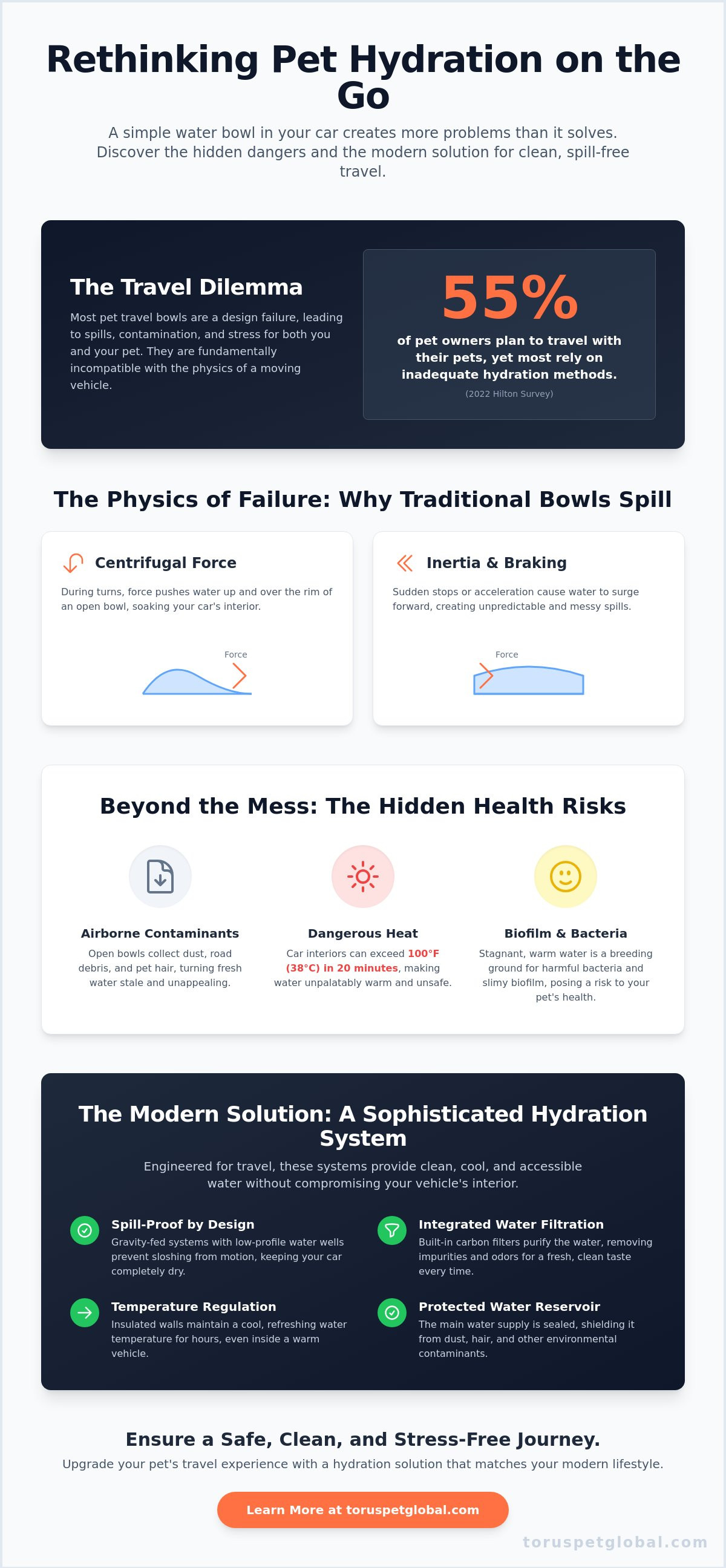
No sloshing. No stagnant dust. No warm, unappealing water. You shouldn't have to choose between a dry car and a hydrated pet. A 2022 Hilton survey found that 55% of pet owners plan to travel with their pets, yet many still rely on basic containers that fail to address the science of hydration.
This guide promises to show you how to maintain cleaner, spill-free hydration using sophisticated design principles. You'll learn how a dedicated hydration solution, rather than a simple bowl, provides peace of mind through filtered, controlled water exposure. We will examine the technology that ensures your pet enjoys fresh water while your modern interior remains pristine.
Key Takeaways
- Understand how centrifugal force affects open water and why specific architectures are required to keep your vehicle interior dry during transit.
- Identify the risks of biofilm and bacterial growth in stagnant car water and how to maintain a cleaner hydration environment for your pet.
- Evaluate the stability of various designs to ensure your dog water bowl for car back seat placement remains secure even during sudden braking.
- Learn to calculate optimal water capacity based on your pet’s size and journey length to ensure consistent hydration without constant monitoring.
- Explore the advantages of sophisticated, gravity-fed systems that protect water from environmental contaminants and the effects of vehicle temperature fluctuations.
Table of Contents
The Dynamics of Hydration in a Moving Vehicle
Water is a dynamic element. In a moving car, it obeys the laws of physics that standard vessels simply aren't designed to handle. When you place a traditional dog water bowl for car back seat use, you aren't just providing a drink. You're introducing a potential mess that reacts to every turn and sudden stop. Centrifugal force pushes water toward the rim during corners, while inertia sends it over the edge when you brake. This unpredictable movement makes open water a liability in any modern vehicle interior.
Pets don't drink like humans do. They require small, frequent sips to maintain equilibrium, especially in the dry, climate-controlled environment of a modern vehicle. Maintaining this accessibility is a core component of holistic dog health. For anxious travelers, the presence of a consistent, familiar hydration source provides a psychological anchor. It transforms a stressful journey into a manageable routine by providing a sense of stability in an ever-changing environment.
The Problem with Open-Dish Hydration
Open dishes are fundamentally incompatible with vehicle interiors. Sloshing water isn't just a nuisance for your upholstery; it creates a damp environment where bacteria can thrive. While some industry products attempt to mitigate this with high sides or tapered lips, they still leave water exposed to the cabin environment. This exposure allows dust and hair to collect in the bowl, compromising water quality before your pet even takes a sip.
Driver distraction is another critical factor. If you're constantly checking the rearview mirror to see if a spill has occurred, your focus isn't on the road. Research indicates that over 80% of pet owners don't secure their pets when traveling in a vehicle, and irregular hydration can lead to lethargy or digestive upset during long transits. Stopping for water every few hours doesn't account for the micro-thirst that occurs between breaks, leaving your pet uncomfortable for long stretches of the journey.
Modern Lifestyles and Mobile Pet Care
Today's pet parents prioritize a seamless blend of aesthetics and utility. A bright, clunky plastic bowl looks out of place in a premium vehicle interior. The shift toward integrated hydration solutions reflects a commitment to design and functionality. You shouldn't have to sacrifice your car's clean aesthetic to ensure your pet's well-being. Modern accessories should complement your lifestyle, not complicate it.
Mobile hydration is a pillar of modern pet health that ensures consistent access to clean water without compromising the cleanliness of your environment. Systems that control water exposure, like Torus Pet, represent the evolution of this category. These designs prioritize the "anytime, anywhere" philosophy, ensuring that hydration is a sophisticated element of travel rather than a logistical hurdle. No mess, no stress, no compromise.
Beyond Spills: Managing Water Quality and Contamination
While many owners focus on keeping their upholstery dry, the hidden challenge of a dog water bowl for car back seat or back seat floor space placement is maintaining water purity. In the confined environment of a vehicle, water quality degrades much faster than it does in a climate-controlled home. Biofilm, a thin layer of bacteria that feels like slime, thrives in the presence of heat and stagnant water. This isn't just an aesthetic issue; it's a biological one that can impact your pet's long-term health.
Vehicle interiors can reach temperatures exceeding 100 degrees Fahrenheit in just 20 minutes when parked in the sun. These rapid fluctuations create a breeding ground for pathogens. According to ASPCA travel tips, providing pets with filtered or bottled water is essential to prevent stomach upset caused by unfamiliar or contaminated sources. Using a system that shields the water supply helps maintain this standard of care during long transits.
Airborne contaminants are another constant concern. Car cabins are filled with dust, pet hair, and road debris that naturally settle into open water surfaces. This creates a "stale" environment that many pets will instinctively avoid, leading to dehydration. Utilizing antimicrobial materials in the construction of the vessel helps reduce the risk of contamination, ensuring the water stays fresh even when the air is not.
The Science of Controlled Water Exposure
Freshness is directly tied to air exposure. When water sits in an open dish, oxygen and light accelerate the degradation of its quality. Sophisticated pet hydration solutions solve this by storing the bulk of the water in an internal reservoir, protected from the elements. This design ensures that only a small amount of water is exposed to the cabin air at any given time.
By keeping the main supply shielded, you prevent the accumulation of sediments and the evaporation of treatment chemicals like chlorine. This results in cleaner water that remains appealing to your pet throughout an eight-hour drive. It is a proactive approach to hydration that moves beyond basic "no-spill" functionality to prioritize biological safety.
Thermal Stability in Travel Bowls
Temperature directly influences how much a dog drinks. Most dogs prefer cool water, but in a car, water quickly reaches ambient cabin temperature. High heat can make water unpalatable, causing pets to reject hydration when they need it most. This is particularly dangerous during summer travel when the risk of heat exhaustion is highest.
Insulated walls are a passive, high-tech way to maintain thermal stability. Systems that utilize thick, double-walled reservoirs help keep water at a refreshing temperature without the need for batteries or power. This insulation protects the water from the rapid heating effect of direct sunlight through car windows. Maintaining a consistent temperature ensures your pet stays hydrated even on long transits. If you're looking to upgrade your travel setup, exploring advanced hydration systems can make a significant difference in your pet's comfort.
Design Frameworks: Comparing Travel Bowl Architectures
Selecting a dog water bowl for car back seat use often leads pet parents to a choice between convenience and performance. While collapsible silicone bowls are a common sight in 66% of U.S. pet-owning households, their design is inherently flawed for a moving vehicle. Collapsible bowls are also easy to tip over when a dog is moving in the car to position for drinking. These flexible structures lack the rigidity required to withstand the lateral forces of a car in motion. When a pet leans in to drink, the soft walls can buckle, resulting in the very spills you intended to avoid. In contrast, rigid architectures provide a stable foundation that maintains its integrity regardless of the terrain.
Durability is not just about resisting cracks; it's about maintaining a hygienic environment over years of use. Cheap, porous materials like fabric or low-grade plastics are difficult to keep truly clean. Over time, these surfaces develop micro-scratches that harbor bacteria, regardless of how often they are rinsed. A sophisticated hydration solution utilizes high-density, food-grade materials that resist degradation and ensure that the water your pet drinks today is as clean as the water they'll drink three years from now.
Reservoir vs. Open-Top Designs
The fundamental difference between a standard bowl and a reservoir system is how they manage environmental exposure. Open-top designs, such as the Prima Pets Collapsible Travel Bowl (available as a 2-pack for $16.99 as of May 2026), leave the entire water surface vulnerable to cabin dust and hair. This exposure accelerates the "stale water" effect described in previous sections.
Systems that control water exposure, like the Torus Pet water dispenser, utilize a hidden reservoir to shield the bulk of the water supply. This low-profile architecture is safer for back seat placement because it lowers the center of gravity. By keeping the water weight distributed at the base, the vessel is much less likely to tip during sudden braking. You can learn more about how these gravity-fed mechanics work to provide a consistent, clean supply without the need for manual refilling.
Stability and Non-Tipping Features
Stability in a car requires more than just a heavy base. It requires a design that accounts for the specific angles of vehicle seating. Many car seats are slightly tilted, which can cause a standard round bowl to slide or lean. Wedge-shaped designs or those with a broad, flared base counteract this tilt, ensuring the water level remains even.
-
Weight Distribution: A full reservoir acts as an anchor, keeping the bowl planted on the seat or floorboard.
-
Surface Grip: Non-slip bases must be effective on both luxury leather and standard fabric upholstery without leaving marks.
-
Low Center of Gravity: Flat, wide architectures are significantly more stable than tall, narrow bottles or hanging fabric bags.
Relying on hanging fabric bowls is often cited as a way to prevent tipping, but these systems are prone to swaying, which creates a "pendulum effect" that can splash water onto your car's headliner. A stationary, rigid system with a high-grip base is the most reliable way to ensure your pet's hydration remains undisturbed. This thoughtful approach to design reflects a modern lifestyle where pet care and vehicle maintenance exist in perfect harmony.
Strategic Placement and Capacity for Back Seat Safety
Safety in a vehicle is often viewed through the lens of harnesses and crates, but the placement of your pet's hydration source is equally critical. An unsecured dog water bowl for car back seat use can quickly become a projectile in the event of sudden braking. While research indicates that over 80% of pet owners do not secure their pets, even those who do often overlook the safety of the accessories surrounding them. Proper placement is about more than just convenience; it's a fundamental component of cabin safety.
The choice between the floorboard and the seat depends largely on your vehicle's layout and your pet's restraint system. The floorboard offers a lower center of gravity and reduces the distance a vessel can travel if moved. However, for pets secured by a short travel harness, the seat is often the only reachable location. In these instances, the stability of a rigid reservoir system is non-negotiable. It must remain planted on the upholstery without sliding, ensuring that hydration is available without becoming a hazard.
Choosing the Right Capacity
Calculating the correct water volume is essential for maintaining a "hassle-free" journey. A standard rule is that dogs require approximately one ounce of water per pound of body weight daily, but this increases in the dry, recirculated air of a car. Matching the capacity to your pet's size prevents the need for frequent, distracting refills.
-
Mini Solutions (34oz): Ideal for smaller breeds and shorter urban commutes where space is at a premium.
-
Maxi Solutions (68oz): Designed for larger breeds or multi-day road trips, providing a significant reservoir that lasts.
Avoid the temptation to "over-fill" a standard open dish to compensate for trip length. This only increases the likelihood of spills and contamination. A sophisticated hydration solution manages the water level for you, dispensing only what is needed while the bulk remains safely stored in the reservoir walls. No over-filling. No splashing. No problem.
Safe Interaction with Seat Covers
Modern pet parents frequently use quilted seat protectors to maintain their vehicle's interior. While these covers protect the fabric, they can create a slick surface that causes traditional bowls to slide. When placing a vessel on these covers, ensure it features a high-grip, non-slip base that can bite into the material. This keeps the water source stationary even during cornering.
Accessibility is the final piece of the puzzle. A pet that is properly harnessed has a limited range of motion, so the vessel must be placed within that specific radius. You can find more detailed advice on how to keep your pet hydrated in a dog car seat while maintaining strict safety protocols. Integrating your hydration strategy with your existing safety gear ensures a seamless, high-tech travel experience for both you and your pet. To find the perfect fit for your next journey, explore our range of advanced pet hydration solutions.
Sophisticated Solutions for Modern Pet Travel
Modern travel isn't just about getting from point A to point B; it's about maintaining a standard of living that reflects your values. For the discerning pet parent, a dog water bowl for car back seat use shouldn't feel like a compromise. It should be a seamless addition to a high-tech vehicle interior. Systems designed for an "anytime, anywhere" lifestyle recognize that hydration is a constant need, not an occasional event. By integrating smart design with daily utility, we can eliminate the mess associated with traditional travel.
Gravity-fed hydration solutions represent a significant leap over manual refilling. These systems use the weight of the water and atmospheric pressure to maintain a shallow, fresh pool without the need for electronic components. No batteries. No power cords. No mechanical failure. This simplicity ensures reliability during long-distance travel, where access to power or constant monitoring is limited. It's a silent, efficient process that works in the background while you focus on the road.
Water quality is further enhanced through integrated carbon filtration. While previous sections discussed the risks of biofilm and airborne dust, active filtration addresses the chemical composition of the water itself. By removing chlorine and common sediments, these systems ensure the water remains palatable and healthy. It's a proactive approach to wellness that aligns with the expectations of modern pet care. Cleaner water isn't just a luxury; it's a fundamental requirement for travel safety.
The Torus Approach to Travel
The architecture of a Torus hydration solution is specifically engineered for the rigors of the road. Its thick, double-walled construction does more than just hold water; it acts as a thermal barrier. This insulation protects the internal supply from the rapid temperature spikes common in car cabins. By shielding the bulk of the water from light and air, the system maintains freshness for much longer than an open dish. A reliable dog water bowl for car back seat placement must be both functional and aesthetically compatible with modern upholstery.
The low-profile, geometric design is a direct response to the stability challenges of vehicle seating. Rather than a high-sided bucket that is prone to tipping, this flat-bottomed reservoir keeps the center of gravity as low as possible. It stays where you put it. You can explore the science behind Torus hydration to understand how these fluid dynamics work together to create a spill-free environment that looks as good as it performs.
Practical Takeaways for Your Next Trip
Hydration is a sophisticated element of modern pet care. As you prepare for your next journey, use this checklist to ensure your setup meets the highest standards of quality and hygiene:
-
Prioritize controlled exposure: Choose systems that store water in a reservoir rather than an open pool to minimize contamination from dust and hair.
-
Invest in antimicrobial materials: High-quality, food-grade plastics help reduce the risk of bacterial growth over time, especially in warm vehicle cabins.
-
Ensure design compatibility: Your pet's accessories should reflect the same quality and design intelligence as your car's interior.
Ultimately, the goal is peace of mind. When you know your pet has access to cool, filtered water, you can enjoy the journey without distraction. Hydration becomes a sophisticated element of travel rather than a logistical hurdle. It's a small but vital upgrade to the modern pet ownership experience.
Elevating the Standards of Pet Travel Hydration
Modern travel requires a shift from basic utility to sophisticated care. We've explored how a dedicated hydration solution manages the physics of a moving vehicle while protecting water from environmental contaminants. By choosing a rigid reservoir system over a standard dog water bowl for car back seat use, you prioritize both your pet's biological health and your car's interior integrity. This approach transforms hydration from a logistical hurdle into a seamless part of your lifestyle.
Effective travel is built on reliability. With over 10 years of innovation in pet technology, Torus provides a BPA-free, eco-friendly construction that pet parents globally trust for stress-free journeys. These systems ensure water remains cool and filtered, regardless of the distance or the destination. No mess. No stagnant water. No compromise. You can now find the perfect hydration solution for your next journey and experience the difference that thoughtful design makes.
Every trip is an opportunity to provide the best for your pet. When you align your travel gear with your high standards for quality and design, the result is a safer, more enjoyable experience for everyone in the vehicle. Safe travels.
Frequently Asked Questions
Can I leave a dog water bowl in the car back seat while driving?
Yes, but only if the vessel is specifically engineered to manage fluid dynamics in a moving vehicle. Standard open bowls are a liability because they lack the stability to handle sudden braking or turns. A 2023 survey found that over 80% of pet owners don't secure their pets or accessories, making low-profile, weighted designs essential for maintaining cabin safety and cleanliness.
What makes a dog bowl "spill-proof" for vehicle use?
A truly effective dog water bowl for car back seat use utilizes tapered rims or internal reservoirs to counteract centrifugal force. These architectures ensure that water remains contained even during sudden stops or sharp turns. It isn't just about the physical weight of the bowl; it's about how the design manages the movement of the liquid to prevent sloshing onto your upholstery.
How often should I change the water in a travel bowl?
Water in an open dish should be changed every two to three hours to avoid the accumulation of cabin dust and pet hair. In contrast, advanced hydration solutions with shielded reservoirs can maintain freshness for up to 24 hours. This protection prevents the degradation of water quality that occurs when liquid is constantly exposed to light and recirculated car air.
Are collapsible silicone bowls safe for long-term use?
While food-grade silicone is safe for short intervals, it is a porous material that can develop micro-scratches over time. These crevices often harbor bacteria that are difficult to remove with simple rinsing. For consistent travel, rigid, non-porous materials provide a more hygienic and durable solution. This ensures that the vessel remains a clean part of your mobile pet care routine for years.
How do I prevent biofilm from forming in my dog’s travel bowl?
Regular cleaning with specialized kits and the use of antimicrobial materials are the primary defenses against biofilm. Biofilm thrives in stagnant, warm water, which is common in car environments where temperatures can fluctuate rapidly. Utilizing a hydration solution designed to reduce air exposure helps limit the biological growth that creates that familiar slippery residue in standard bowls.
Does a dog water bowl for a car need to be filtered?
Filtration is a vital component for maintaining water quality and encouraging consumption in unfamiliar environments. Removing chlorine and sediments ensures the water remains palatable, which is essential for preventing dehydration during long transits. Systems that control water exposure often include integrated carbon filters to ensure every sip is clean and free from common road contaminants.
What is the best way to secure a water bowl on a leather car seat?
Using a hydration solution with a high-grip, non-slip base is the most effective way to secure a dog water bowl for car back seat placement on leather. These materials provide necessary friction without leaving marks or residue on premium upholstery. For maximum stability, placing the vessel on the floorboard remains the preferred option among design-conscious pet parents who value vehicle aesthetics.
How much water does a large dog need for a 4-hour car trip?
A large dog typically requires 15 to 20 ounces of water during a 4-hour trip, depending on the cabin temperature and the pet's activity level. Since the dry, climate-controlled air in a car increases thirst, having a 68oz capacity reservoir is ideal for ensuring consistent access. This allows for worry-free travel without the need for frequent, manual refills during your journey.


